A poem speaks to us with words and the words convey images and feelings. The moving image is a poem already. In the clip below, from 35 Rhum, Denis achieves a lot without words. What we see is a poem in the eyes and the poetry of the body. Dance opens chains and ties a few more. The ethno-urban tone of the setting is clear. The movie is an adaptation of Ozu's Late Spring. What you see below is a poem. Words are quite un-necessary subsequently.
Friday, November 12, 2010

Thursday, November 11, 2010
Hour of the Wolf
 The Bergman world exists here in all it's hermetic essence, an island, a couple and wind swept shores. Johan, an artist, a painter, has vanished, his wife looks at the camera and speaks to us, after we hear the noises of film making, the directors voice too. Johan has vanished but Alma will continue to stay on the island, why has Johan vanished, she does not understand. Told from her perspective and his dagbok, Hour of the Wolf traces Johan's descent into paranoia and madness. He sees figures and hears people talk to him and follow him. It is a descent into a psychotic world, which his wife begins to share with him at times. Often he is chased by people, talks to them. Are these visitations real? And then a visit from a man who supposedly owns the island and an invitation for dinner at his castle. The Gothic ingredients are thus complete. But not before that a visit from a past lover, Veronica Vogler. She will be at the castle too, he is told.
The castle dinner hosted by the rich family is a great favourite of mine. With the camera panning in arc like swishes, Johan drinks and suffers, Alma sees him drink and suffer, and later, he defends the creed of the true artist. Back home, Johan tries to kill Alma and Alma flees. Johan is at the castle again where he tries making love to Veronica's corpse, who wakes up and breaks into hysterical laughter. Johan is then attacked by the castle occupants, and in true horror style, nibbled at. Alma later on faces the camera and wonders if she could have done more. Johan runs away from the castle, and vanishes on the way. Alma helps construct the events leading to Johan' disintegration.

One of the most erotic and abiding images in this movie personally for me is when Johan, sitting on his own trying to paint feels a presence. From the left side of the screen we see a figure approach. Then we see legs, a fe minine figure and as she gets closer, we see feet, as they approach and she sits down near Johan, and then bares her breast to him. It is Veronica Vogler, played by the hauntingly beautiful Ingrid Thulin. There are some beautiful scenes on this windswept island and the castle scenes are enacted with a lot of Hollywood panache and perhaps a parody of the genre. Max Von Sydow plays the tormented artist. I saw him recently in a Di Caprio movie and thought he still is magnificent. Ullman plays the wife and tormented soul par excellence as usual. She bares lets you on to her though there are moments of understanding. Her seductive charms seemed to be lost on Johan who was lost in a different world.
minine figure and as she gets closer, we see feet, as they approach and she sits down near Johan, and then bares her breast to him. It is Veronica Vogler, played by the hauntingly beautiful Ingrid Thulin. There are some beautiful scenes on this windswept island and the castle scenes are enacted with a lot of Hollywood panache and perhaps a parody of the genre. Max Von Sydow plays the tormented artist. I saw him recently in a Di Caprio movie and thought he still is magnificent. Ullman plays the wife and tormented soul par excellence as usual. She bares lets you on to her though there are moments of understanding. Her seductive charms seemed to be lost on Johan who was lost in a different world.Wednesday, November 10, 2010
Mamma Roma
 Mamma Roma opens with an image or rather with a painting or the subversion of a painting. Christ's last supper and here Mamma Roma herself, loud and ebullient, inviting pigs to her ex- pimp's wedding feast. Pasolini begins with aggression and a distance from the first scene, and from a distance, the shot of a long wide table. Mamma Roma punning and singing, and we are suddenly privy to her world, this ex-prostitute, who wants to take her son Ettore to the outskirts of Rome, to bring him up as an untainted young man, away from the taint of her ex-profession. Near Rome, the recurrent theme, the ruins, the empty fields, the collections of garbage and rubbish, cathedral domes, long serene and clear shot of a clear sky and Mamma Roma, nameless, Mamma Roma to every one, to her son too, unknowing of her mother's profession of the past. The new scene finds Ettore hanging with bums as his mother opens a stall and sells vegetables now. Her ambition is to graduate to the petit -bourgeois, she attends the church, her eyes are on the daughters of respectable bourgeoisie families, she does what mothers do.
Watching Mamma Roma is nothing short of a drug, an addiction. The two shots of Mamma Roma walking towards us, long sequences, in the dark, the night, delivering two monologues, one crisp and bitingly sarcastic, the other mellow and melancholic, behind her the lights of Rome, nothing visible except darkness and as she walks, she looks at the camera, directly at us, joined by other citizens of the night, who walk and who she leaves behind, the sinuous walk, the serpentine ease, the following gaze, Mamma Roma dares to shock. In the second of these shots, Mamma Roma says that she has an awful ache in her stomach, like I ate my heart out. Ettore has become what she didn't want him to, a common thief, a bum. She tries to lure him away from Bruna, a girl he gives gifts to, who has slept with all Rome. Ettore driving with his mother on his new bike, with his mother clasping his waist tight, I remember this image too, the defiance of her eyes, her language.

Pasolini's A violent life, that I read last year, has similar characters, bums and thieves and prostitutes and pimps, the hangers on, the ruins outside Rome, the fights, the scrapes the dispossession, the marginalized. Mamma Roma wants a piece of that respectability, for her son, for herself. However, Carmine, her ex-pimp returns, he threatens, she must walk the streets again, the highway as Mamma Roma describes it, otherwise he will disclose it to Ettore. The long second monologue shot follows this piece of blackmail, a battered sad Mamma Roma this time, very morose, very bitter. Then Ettore gets caught stealing a radio, gets locked and tortured in a police cell, strapped, almost crucified. Here Pasolini subverts the crucifixion image, the shot is a horizontal one, Ettore cries for mercy, Mamma he cries, save me. Later Mamma Roma, eating bread dipped in milk, looking at the threatening suburban landscape outside, cries for her son, he was innocent she claims, why him?
Ettore's body language is very striking. He sleep -walks through the movie, he seems lazy, very disinterested, not caring at all. There is a lethargy in his body, a lack of motivation in his movements, it translates in how he moves, how he walks. Later he has a bright fever, he is almost besides himself, and later still, he seems restored to himself but suffering as he is strapped now, tortured, bruised, he dies. With Ettore too, Mamma Roma tangos, as she teaches him to, echoes of an Oedipal type, clasping to his waist later on, we are never told who his father is, how he was raised, as she claims Ettore, he must get out of this useless way of his, learn a trade, after all she would get on the cross for her.
Anna Magnani's performance in this movie can be described as a tour de for
 ce, a mesmerizing performance, a piece of acting that confirms the power of cinema, a powerhouse character that she fills with the oddities of her laugh, the black messy hair, the humour, the loud voice, her songs, her sorrow her ambition, her desires her contradictions. Magnani's performance in Mamma Roma is one of the most powerful in all cinema and can only be described with adjectival prolixity. The mind numbs when she walks, little black bags under her eyes, Mamma Roma of the suburbs, of the streets, of dark nights and calm mornings, of the vegetable stall, of figs and artichokes and cunning little schemes, the donna of the streets, the mother, the balancing trapeze artist.
It is all to easy to say this is a movie of social protest. What sets this movie apart from such movies is Pasolini's superior art, for in one blow, he delivers everything. It is perhaps fair to say that he is a Marxist and Catholic in one given moment, a skeptic and mystic combined. His images are those that he revers and subverts. Pasolini combines herein his manifold genius of a philosopher and politician, the writer and camera aesthete and above all, Pasolini the poet, Pasolini the dangerous poet. Mamma Roma looks outside from the window of Ettore's prison cell, restrained by the fruit sellers and other bums, as she tries to throw herself out of the window. The last shot, the most dangerous, the most powerful, the most subversive, Rome at a distance, the emptiness between the two, the dome of a cathedral, the indifferent haze of the day, the loneliness of Mamma Roma, the futility of her ambitions.
Tuesday, November 09, 2010
Nights of Cabiria
 Cabiria has been a prostitute for as long as she remembers. Once she remembers, she had long black hair, it fell to her shoulders, she would go out with her madre, life was different then, she was young. Who can she trust now? She was nearly drowned by her pimp and her money was stolen not long ago, this is her life, exploited by all, pimp or no pimp. It takes a hypnotist to unravel her life, her desires, talk about her madre, her long black hair falling to her shoulders. And now this man, this new man, what does he want? He appears well meaning, brown skinned with black hair, she is afraid but what the hell, Cabiria must try again. As Cabiria walks alone, in the end, desolate and heart broken, robbed off all her money, the new lover just another fraud, another disappointment, she looks at the camera, image of broken hopes and dreams, and some steel too. The smile says it all. The last scene is worth millions.
Fellini's Nights of Cabiria is pre-fantasy Fellini, extremely brutal in his treatment of the themes that were his concern around that time of his film making. The script was co-authored by Pasolini and has some extremely memorable lines, some very memorable scenes. I like Cabiria in the rain, I like Cabiria walking and running, with Chaplin like energy. I adore the last scene. I can watch it endlessly. The last scene is a poem. The performance by Giulietta Masina is phenomenal. She owns the character. She reminds me of Anna Mignani from Mamma Roma, in the certitude of her performance. She exemplifies that performance, that character. She is filled with solitude, she is a solitary person. Her smile hides her solitude, her loneliness. She has always been betrayed, she must live in Rome or thereabouts. Not for her is a family life, a country home, a husband, children. No, Cabiria must live to fulfill that destiny, the fierce solitude of that life.
Nights of Cabiria is a great movie and some scenes are poems in themselves. Truly a memorable film, Nights of Cabiria is relentlessly melancholic, a very sad movie about a desperately unhappy person.
Friday, November 05, 2010
Thursday, November 04, 2010
Tokyo Monogatari

At first everything seems all right. An elderly couple visit their grown up children in Tokyo and nothing appears to be amiss. Then Ozu Yasujiro shows us what looks like a wound. With a knife, he starts scraping the edges of this seemingly benign looking wound and then, relentlessly, he plunges this knife into this festering festering wound. The elderly couple are welcome at their son's house but he has no time for them. Neither does her daughter. They visit one child first and then the other and the only person who takes time out for them is their dead son's widow. The couple are soon booked to visit a spa, which proves a lonely and trying time for them. They return to find their daughter as unwelcoming and as busy as before. The children are considerate but too busy. In the end the couple return home and the ailing mother dies. The children come late but leave soon afterwards as their busy lives command them. And so life moves on.
The most striking things are not that the children are busy but that the couple are resigned to see their hopes dashed. In this resignation is a mix of hope and longing, mixed as both are from events in a distant past, when their children where young, when their children were theirs. Ozu is never benign in his portrayal of this theme. Far from it, when the elderly couple cannot sleep at the spa because of all the revelry going on there, both husband and wife lie fanning themselves, looking resolutely at the ceiling, the husband in his patient fury, the wife in her impotent resignation. He gets up in defiance of something and the next mesmirizing scene, both facing a silent sea is an indelible image in all cinema. It has not just rage written all over it but conveys the futility of all life, all relationships, all hopes and all expectations. the elderly man, played by Chieko Higashiyama is a portrait of stolid acceptance of the couple's circumstances. Children and parents drift apart he reminds his young unmarried daughter, he knows no other way to describe it.
It is usual in film circles to debate which is the greatest movie ever. Tokyo Story as it is also known as, has consistently been voted in the list of all the top ten movies ever made. I find that personally pointless. I remember having read recently that watching Japanese cinema can be dangerous. I find that an apt description in many ways. I always remember Fassbinder when I watch Ozu, though the styles are so different. Fassbinder once wrote that all stories are crime stories. The children here are self-absorbed, they are not cruel, at least not on the surface. I find that the crimes in the family set-up are committed everywhere and by everyone, what Fassbinder describes as the fascism of relationships. The dangerousness of this cinema, its so-called menace is a reflection of our own moral compromise. This must also seen against the break up of the family structure and the transition from agrarian to so-called Western ways of life. The elements of post-war Japan figure in a very noticeable way in Ozu's movies.
Ozu has no intention of removing the knife he has driven in the wound, either in this movie or elsewhere. It is upto the viewer to either acknowledge that wound or to live with that knife.
Ozu has no intention of removing the knife he has driven in the wound, either in this movie or elsewhere. It is upto the viewer to either acknowledge that wound or to live with that knife.
Wednesday, November 03, 2010
Late Autumn
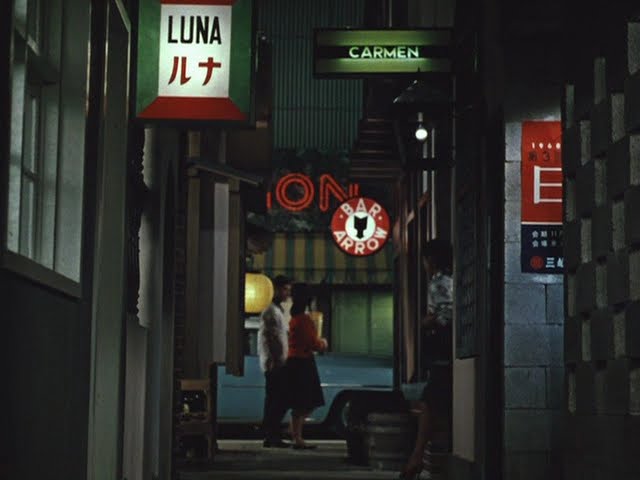
Ozu Yasujiro's Late Autumn continues the central theme of traditional values and family life which is a characteristic feature of Ozu's oeuvre. Made just before An Autumn Afternoon, it would be silly to use cliched formulas to describe this film, however, sometimes one resorts to over used cliches and one has no choice. In my very considered opinion, this movie is an intense masterpiece. It begins and ends with a colour schematic which represents Ozu's subdued depiction of plot and characterization. The interior is green-grey and aquamarine, it is autumn, again the tones are dulled, the signal trees, leafy autumn, the aftermath of mourning, the colour of melancholy, the so-called minimalist interiors, the economy of expression, the discipline of emotion, the subdued pain.
I think this is one Ozu movie which, on second viewing recently, I found with pervading sadness even in its lighter moments, and lighter moments it has. Akiko and her young daughter are shown together with her dead husband's friends at a funeral ceremony. The friend's recollect the times whn they knew Akiko as a salesperson at a chemists when they were all young, and how they all pretended to be ill to go and see her. All their efforts are unrequited and now, years later, they plan, at first frivolously and later with some seriousness Ayako's and even Akiko's marriages. Akiko, the mother, stays unknowing of all these plans and behaves in a dignified manner when Ayako wrongly assumes that her mother is planning to get married too. The bond between the friends and their Friend's widow is affectionate and strong and nowhere does it lapse into silly sentimentality or any profuse excess of emotions. Akiko finally decides to continue to live as a widow, in this autumn of her relational life even though she is quite young. Yuriko, Ayako's friend, leads a spirited defense of Ayako's position after her daughter blames her mother but it all ends in restoring what seems to be an appropriate end.
Ozu's treatment of this theme shows the women as very independent and strong willed and the backdrop of the traditional versus the modern is cleraly an important part of his concerns. The performances are heart warming, especially Setsuki Hara's as Akiko, who was central to many Ozu movies. I particularly enjoyed Okada Mariko's Yuriko as a very charming portrayal of this very effervescent young woman, who takes on the three well meaning and scheming men. The scene when they all have sushi at her mother's restaurant is brilliant in its complex simplicity. Well, that is Ozu, extremely complex, seemingly, disarmingly telling us tales about family and values and life and love and yet, like Early Spring, which this movie is so close to, surrounding the sensitive viewer, even in his or her casual voyeurism, with a life that most strikingly shows the sadness, the ennui, the melancholy of cycles which life is composed of, which we live. All of Ozu's trademark technicalities are in evidence here, including the ellipses, the elides in the story. I thought, the movie is a magnificent example of sensitivity towards one self and others. The sets and the street scenes are lavish in their economy, their delicacy. Late Autumn is a movie that grows on you, that needs multiple viewings.
Tuesday, November 02, 2010
Late Foucault
In an excellent appraisal of Foucault's lecture series at the College de France , Michael Hardt writes about the later books in this series, some of which are yet to appear in English. The two books in question, The Government of Self and Others and The Courage of Truth are the subject of Hardts' review in the NLR. Since the middle of this year, I have been reading the lecture series and have so far read most of Psychiatric Power, Society must be defended, Security, Territory, Population and am currently reading The Government of Self and Others.
Contrary to his early style which many including myself find inaccessible, Foucault's style towards the later phase of his life is perhaps simpler and easier to understand. Foucault draws upon inexhaustible sources of erudition and much of what we read among contemporary philosophers is influenced by Foucault. Foucault elaborates upon his concept of Biopolitics, further written about and commented upon by Agamben later on. The style of these lectures is brilliant, direct and though not interspersed with questions, it takes account perhaps of those questions which the great philosopher might have anticipated. Foucault speaks like the master and his inexhaustible knowledge seemingly has all the answers.
Contrary to his early style which many including myself find inaccessible, Foucault's style towards the later phase of his life is perhaps simpler and easier to understand. Foucault draws upon inexhaustible sources of erudition and much of what we read among contemporary philosophers is influenced by Foucault. Foucault elaborates upon his concept of Biopolitics, further written about and commented upon by Agamben later on. The style of these lectures is brilliant, direct and though not interspersed with questions, it takes account perhaps of those questions which the great philosopher might have anticipated. Foucault speaks like the master and his inexhaustible knowledge seemingly has all the answers.
Monday, November 01, 2010
Brise marine
The flesh is sad......and I've read every book.
O to escape.......to get away. Birds look
as though they are drunk for unknown spray and skies.
No ancient gardens mirrored in the eyes,
nothing can hold this heart steeped in the sea.....
not my lamp's desolate luminosity
nor the blank paper guarded by it's white
nor the young wife feeding her child, O night!
I'm off! You steamer with your swaying helm,
raise anchor for some more exotic realm!
Ennui, crushed down by cruel hopes, still relies
on handkerchief's definitive goodbyes!
Is this the kind of squall- inviting mast
the storm winds buckle above shipwrecks cast
away......no mast, no islets flourishing?......
Still, my soul, listen to the sailors sing!
Mallarme, Translated by E.H & A.M Blackmore
O to escape.......to get away. Birds look
as though they are drunk for unknown spray and skies.
No ancient gardens mirrored in the eyes,
nothing can hold this heart steeped in the sea.....
not my lamp's desolate luminosity
nor the blank paper guarded by it's white
nor the young wife feeding her child, O night!
I'm off! You steamer with your swaying helm,
raise anchor for some more exotic realm!
Ennui, crushed down by cruel hopes, still relies
on handkerchief's definitive goodbyes!
Is this the kind of squall- inviting mast
the storm winds buckle above shipwrecks cast
away......no mast, no islets flourishing?......
Still, my soul, listen to the sailors sing!
Mallarme, Translated by E.H & A.M Blackmore
Sunday, October 31, 2010
Literature + Illness = Illness
Roberto Bolano's The Insufferable Gaucho has a memorable essay called Literature + Illness = Illness, written whilst he was waiting for a liver transplant at a specialist hospital in Barcelona. The essay is dedicated to his hepatologist. The essay is essentially a contemplation on mortality, including the writer's own mortality. Thinking about such things in a huge elevator with his Japanese doctor, Bolano thinks of what goes through the minds of people who know are going to die, like himself. What do hey think of before dying? He then writes about the association between illness and things like height, with Dionysus, with Literature and poetry. Where does reading get us, he asks. Reading is like having sex says Bolano. Ultimately it is a finite activity in an infinite sea of books, in an infinite possibility of sex. Essentially he thinks that reading one book is equal to reading all, where does it lead us?
Bolano beautifully paraphrases Mallarme' Brise Marine and Baudelaire's The Traveller. The Mallarme' poem translation that Bolano has chosen is my own personal favourite. The flesh is sad and I have read every book, wrote Mallarme. Taking this further, Bolano says that reading and sex have gotten this reader nowhere. The real essence is in travel. Travelling can be the only saving grace against the ills of the modern world, traveling as a prescription for our neuroses. Not the traveling prescription of modern times but of yore, traveling for months together, for years. Bolano remembers traveling in his fathers truck in a landscape in Chile that he describes as post-nuclear and then in Mexico and later on in Spain, where he lies ill as he writes this essay.
Towards the end of this essay, Bolano is reflectively thinking about Kafka, Kafka having said that " nothing could come between me and my writing". Thinking about this, Bolano thinks that " travel, sex and books are paths that lead nowhere except to the loss of self, and yet, they must be followed and the self must be lost, in order to find it again, or to find something, whatever it may be - a book, an expression, a misplaced object........in order Rodin anything at all, a method perhaps, and, with a bit of luck, the new, which has been there all along".
The concerns of this essay have plagued me since long. But read one must, even if ultimately it is a solitary pursuit unlike sex generally and travel though the latter is an exception. Bolano's concerns are expressed through the prism of reflections of a nearly dead man, a dying man, a terminally ill man and hence this essay reflects that mood. The style is unlike that of his novels which are faster and pacier , unlike this essay which has mellifluous music and the sadness of ennui, the ennui that the Mallarme poem spoke of, the oases of fear that Baudelaire wrote of, the malaise of modern life, the romance of reading, the hope to find something new.
Reading leads us nowhere eventually and gives us no answers. I have read one book means that I have read all the books. The flesh is sad, why did Mallarme write that asks Bolano. It at least may lead us to an abyss eventually even if that abyss too is unrevealing.
Bolano beautifully paraphrases Mallarme' Brise Marine and Baudelaire's The Traveller. The Mallarme' poem translation that Bolano has chosen is my own personal favourite. The flesh is sad and I have read every book, wrote Mallarme. Taking this further, Bolano says that reading and sex have gotten this reader nowhere. The real essence is in travel. Travelling can be the only saving grace against the ills of the modern world, traveling as a prescription for our neuroses. Not the traveling prescription of modern times but of yore, traveling for months together, for years. Bolano remembers traveling in his fathers truck in a landscape in Chile that he describes as post-nuclear and then in Mexico and later on in Spain, where he lies ill as he writes this essay.
Towards the end of this essay, Bolano is reflectively thinking about Kafka, Kafka having said that " nothing could come between me and my writing". Thinking about this, Bolano thinks that " travel, sex and books are paths that lead nowhere except to the loss of self, and yet, they must be followed and the self must be lost, in order to find it again, or to find something, whatever it may be - a book, an expression, a misplaced object........in order Rodin anything at all, a method perhaps, and, with a bit of luck, the new, which has been there all along".
The concerns of this essay have plagued me since long. But read one must, even if ultimately it is a solitary pursuit unlike sex generally and travel though the latter is an exception. Bolano's concerns are expressed through the prism of reflections of a nearly dead man, a dying man, a terminally ill man and hence this essay reflects that mood. The style is unlike that of his novels which are faster and pacier , unlike this essay which has mellifluous music and the sadness of ennui, the ennui that the Mallarme poem spoke of, the oases of fear that Baudelaire wrote of, the malaise of modern life, the romance of reading, the hope to find something new.
Reading leads us nowhere eventually and gives us no answers. I have read one book means that I have read all the books. The flesh is sad, why did Mallarme write that asks Bolano. It at least may lead us to an abyss eventually even if that abyss too is unrevealing.
Friday, October 29, 2010
The Sound of the Mountain

I feel that if I had to read only one novel for a whole year and never hope of it ending, then I would choose The Sound of the Mountain by Kawabata Yasunari. I would just relish seeing Shingo busy in his routine, coming back home and chat to his daughter-in-law kikuko and think of his lingering love for his wife' dead sister. What better than see his growing affection for Kikuko, with whom his bond is unwritten and unsaid, Kikuko of the sad eyes and clear forehead, Kikuko of the bright Kimono and tight Obi, Kikuko of the graceful shoulders and melancholy eyes, the sad Kikuko, the unloved Kikuko, whose husband Shuichi prefers a geisha. Fusako, Shingo' daughter is estranged from her husband, she brings unrest to her parents house, she is unhappy, she too is sad, there is melancholy that drifts in and out of the Shingo household. At night, Shingo, now in his sixties, fears the ravages of memory, hears the sound of death, fears death, hears the sound of the mountain, hears too his own longing, the failed love for his dead sister-in-law, he sees her in dreams. Shingo's memory is failing, he thinks about the lives of his loved ones and at times blames himself for Shuichi' failings.
Shingo's moral crisis forces him to have a meeting with Shuichi's geisha. Around the same time, Kikuko secretly has an abortion, refusing to have Shuichi' child whilst Shuichi' geisha , also pregnant from Shuichi decides to have the child. Shingo pays her money after she has separated from Shuichi, and the geisha Kino withdraws away. Kikuko returns home, Shuichi starts spending more time with her, though he does declare to Shingo that she is a free agent, on hearing which Kikuko cries, adamant that she won't leave, especially Shingo. Life resumes again, Fusako's husband has survived a suicide attempt, there is talk of Fusako opening a stall with Kikuko offering to help, there is a plan for a family holiday, the seasons have passed a full circle, we have seen the sunflowers and the cherry trees, the maples too, and heard the hissing of the mountain.
This is Kawabata territory, fierce in its ambiguity, in its passing and unpassing hours, its passing and unpassing time, its recreation of a lost romance in changing minds, its hints, its provocations, its subtle and not so subtle suggestions, the romanticism, the loneliness, the eroticism of everything he creates, the mood, the atmosphere, the longing the desire, the stirrings of memory. The tale ends in ambiguous melancholy, the relations between the characters are shaded by restraint and sadness. Shingo is not emotionally close to his wife, he finds in Kikuko the daughter he doesn't find in Fusako and yet he has a soft almost erotic affection for Kikuko though it is never described with distaste. The almost disdainful attitude which Shuichi has for his wife I find something difficult to accept but then I am not privy to the cultural elements of geisha life and the moral implications it might have for Japanese sensibilities. All geisha's are not mistresses and as Shingo lies in the arms of a geisha once, he finds a calmness in that embrance if not just plain physical arousal.
I do not know if the novel could have been written from multiple perspectives for while on the one hand Kikuko's sadness is described with both direct and indirect ways, yet her attitude towards Shuichi is not described at all because it is never discussed. In other ways, with geisha's in the background, all these women floating in and out are persistent acts to which any sensible woman should act against and yet, there are no signs of revolt. Kikuko does rebel, by having an abortion and yet settles in again but does she come back for Shingo instead? Does Kikuko know or feel that her downy hair on her neck appeals to her father-in-law, does she know that the shrug of her shoulders, her bright Kimono, her tight Obi arouses in Shingo memories of his previous love and current erotic desire?
Much and I feel everything is left in shade and doubt. The mood of this novel is mysterious, it is almost scary in its contemplation of moral crises, though it is softer in its eventual ending compared to Soseki's novels. I will linger outside the Shingo household veranda as Shingo will look at the distant mountain, thinking of death and Kikuko and I will linger to wait as Kikuko comes out to water the cherry trees, dressed in her bright Kimono, her tight Obi, Kikuko of the beautiful shoulders, the sad eyes with the downy hair on the nape of her neck.
This is Kawabata territory, fierce in its ambiguity, in its passing and unpassing hours, its passing and unpassing time, its recreation of a lost romance in changing minds, its hints, its provocations, its subtle and not so subtle suggestions, the romanticism, the loneliness, the eroticism of everything he creates, the mood, the atmosphere, the longing the desire, the stirrings of memory. The tale ends in ambiguous melancholy, the relations between the characters are shaded by restraint and sadness. Shingo is not emotionally close to his wife, he finds in Kikuko the daughter he doesn't find in Fusako and yet he has a soft almost erotic affection for Kikuko though it is never described with distaste. The almost disdainful attitude which Shuichi has for his wife I find something difficult to accept but then I am not privy to the cultural elements of geisha life and the moral implications it might have for Japanese sensibilities. All geisha's are not mistresses and as Shingo lies in the arms of a geisha once, he finds a calmness in that embrance if not just plain physical arousal.
I do not know if the novel could have been written from multiple perspectives for while on the one hand Kikuko's sadness is described with both direct and indirect ways, yet her attitude towards Shuichi is not described at all because it is never discussed. In other ways, with geisha's in the background, all these women floating in and out are persistent acts to which any sensible woman should act against and yet, there are no signs of revolt. Kikuko does rebel, by having an abortion and yet settles in again but does she come back for Shingo instead? Does Kikuko know or feel that her downy hair on her neck appeals to her father-in-law, does she know that the shrug of her shoulders, her bright Kimono, her tight Obi arouses in Shingo memories of his previous love and current erotic desire?
Much and I feel everything is left in shade and doubt. The mood of this novel is mysterious, it is almost scary in its contemplation of moral crises, though it is softer in its eventual ending compared to Soseki's novels. I will linger outside the Shingo household veranda as Shingo will look at the distant mountain, thinking of death and Kikuko and I will linger to wait as Kikuko comes out to water the cherry trees, dressed in her bright Kimono, her tight Obi, Kikuko of the beautiful shoulders, the sad eyes with the downy hair on the nape of her neck.
Thursday, October 28, 2010
the loose gazing of our eyes which is endless
What follows below is a daydream, a rendering of 'the loose gazing of our eyes which is endless' from Apollinaire' The Mirabeau Bridge.
this is all a dream, we never met really, it is a fable, our touches had the fate of distance destined from the beginning, we lingered in the arc of our shadows, our shadows stretched from one to the other, under the shadow of the world, beneath the shadow of ourselves, under the hesitant union of our shadows we lingered a while didn't we, we sat together often, under the shade of crimson autumn leaves, looking often at the lines of our hands, looking for some meaning in the shadows that shaded us, shadows that stretched from me to you, and from you to me. we gazed loosely at each other, often lingering in the shadow of those gazes, we thought that this time would outlast the bitterness of lonely hours, hours that crept so often between us, hours of solitude and meeting, at the edge of those gazes, within the arc of those hours, at the periphery of your scent.
your scent your smell, the iris of your eyes, lie I would if I didn't think that I saw in them my destiny, in the discreet shadow of your arms the destiny of my mouth, in the shadow of your arms the meaning of my shadow, between those gazes the unruffled warnings of my desire, the stirrings of my touch, the unsaid ruffling of your lips, the movement of your lips, the smell of your lips, the scent of your days, the meaning of your nights, my eyes never met your eyes I admit, your eyes never sought my eyes in open unrestraint, yet didn't our gazes linger endlessly on those moments between us that were shadowless, didn't I seek the water of your mouth didn't I seek the heaviness of my touch on you though I didn't tell you so?
my eyes will forever seek the fresh iris of your eyes, after you open your blinking eyes, after you have swept away with your wet fingers the loose strands of your hair that keep getting in the way of our gaze, after you open your eyes unhesitantly to my fresh questions to my fresh eyes, I will not let the old images that fall on your eyes come in the way of the new gaze, come near sit near me, it is autumn again, the streets of my memory are littered with your memory, come unhesitant come again come and seek in my eyes the loose gazing of our eyes which is endless even if it is only a dream.
this is all a dream, we never met really, it is a fable, our touches had the fate of distance destined from the beginning, we lingered in the arc of our shadows, our shadows stretched from one to the other, under the shadow of the world, beneath the shadow of ourselves, under the hesitant union of our shadows we lingered a while didn't we, we sat together often, under the shade of crimson autumn leaves, looking often at the lines of our hands, looking for some meaning in the shadows that shaded us, shadows that stretched from me to you, and from you to me. we gazed loosely at each other, often lingering in the shadow of those gazes, we thought that this time would outlast the bitterness of lonely hours, hours that crept so often between us, hours of solitude and meeting, at the edge of those gazes, within the arc of those hours, at the periphery of your scent.
your scent your smell, the iris of your eyes, lie I would if I didn't think that I saw in them my destiny, in the discreet shadow of your arms the destiny of my mouth, in the shadow of your arms the meaning of my shadow, between those gazes the unruffled warnings of my desire, the stirrings of my touch, the unsaid ruffling of your lips, the movement of your lips, the smell of your lips, the scent of your days, the meaning of your nights, my eyes never met your eyes I admit, your eyes never sought my eyes in open unrestraint, yet didn't our gazes linger endlessly on those moments between us that were shadowless, didn't I seek the water of your mouth didn't I seek the heaviness of my touch on you though I didn't tell you so?
my eyes will forever seek the fresh iris of your eyes, after you open your blinking eyes, after you have swept away with your wet fingers the loose strands of your hair that keep getting in the way of our gaze, after you open your eyes unhesitantly to my fresh questions to my fresh eyes, I will not let the old images that fall on your eyes come in the way of the new gaze, come near sit near me, it is autumn again, the streets of my memory are littered with your memory, come unhesitant come again come and seek in my eyes the loose gazing of our eyes which is endless even if it is only a dream.
Wednesday, October 27, 2010
The Mirabeau Bridge
Under the Mirabeau Bridge the Seine
Flows and our love
Must I be reminded again
How joy came always after pain
Night comes the hour is rung
The days go I remain
Hands within hands we stand face to face
while underneath
The bridge of our arms passes
The loose wave of our gazing which is endless
Night comes the hour is rung
The days go I remain
Love slips away like this water flowing
love slips away
How slow life is in its going
And hope is so violent a thing
Night comes the hour is rung
The days go I remain
The days pass the weeks pass and are gone
Neither time that is gone
Nor love ever returns again
Under the Mirabeau Bridge flows the Seine
Night comes the hour is rung
The days go I remain
Translated by W.S. Merwin, G. Apollinaire
Flows and our love
Must I be reminded again
How joy came always after pain
Night comes the hour is rung
The days go I remain
Hands within hands we stand face to face
while underneath
The bridge of our arms passes
The loose wave of our gazing which is endless
Night comes the hour is rung
The days go I remain
Love slips away like this water flowing
love slips away
How slow life is in its going
And hope is so violent a thing
Night comes the hour is rung
The days go I remain
The days pass the weeks pass and are gone
Neither time that is gone
Nor love ever returns again
Under the Mirabeau Bridge flows the Seine
Night comes the hour is rung
The days go I remain
Translated by W.S. Merwin, G. Apollinaire
Monday, October 25, 2010
on certain evenings
certain evenings bring fierce pain
just after sunset, and a little before total darkness
comes a strange feeling. often in the past
I thought it was a longing for familiar habits
or pure sentiment or just missing those that I truly miss.
but this nameless ceaseless emptiness is more
than mere longing or nostalgia. sometimes it comes as soon as
I hear a sad song played in a language that I do not
know. sometimes the way the traffic lights change
and reflect and burn in a restaurant window, you know that feeling?
the beautiful girl dining inside sitting opposite
a man oblivious of her beauty, the missed heartbeat of that moment,
you know what i am talking about?
the way the high street feral cat hides his anguish behind anger,
on the main street, that gives me endless pain too.
sometimes there is no reason in all this you see, you have gone
your way, and soon everything will be forgotten, you and me
and the cat and the beautiful girl. even smoking cigarettes
does not help, even one after the other. the calm of burning candles
does not kill the anguish of real or imagined pain.
just after sunset, and a little before total darkness
comes a strange feeling. often in the past
I thought it was a longing for familiar habits
or pure sentiment or just missing those that I truly miss.
but this nameless ceaseless emptiness is more
than mere longing or nostalgia. sometimes it comes as soon as
I hear a sad song played in a language that I do not
know. sometimes the way the traffic lights change
and reflect and burn in a restaurant window, you know that feeling?
the beautiful girl dining inside sitting opposite
a man oblivious of her beauty, the missed heartbeat of that moment,
you know what i am talking about?
the way the high street feral cat hides his anguish behind anger,
on the main street, that gives me endless pain too.
sometimes there is no reason in all this you see, you have gone
your way, and soon everything will be forgotten, you and me
and the cat and the beautiful girl. even smoking cigarettes
does not help, even one after the other. the calm of burning candles
does not kill the anguish of real or imagined pain.
Akutagawa's Robbers

If reading fiction meant that some kind of illumination is expected, then that would be reading for the wrong reasons. If one reads sometimes to lessen one's misery, that too is an odd reason. Since I don't know the primary reason behind reading, may I say that if one wants to be enchanted and discomforted at the same time, if one wants to be hypnotized and saddened in one instance, then one must not look further away but pick up your Akutagawa. In Akutagawa Ryunosuke, Japanese Literature gives us many reasons to carry on reading. Reading Akutagawa is drinking of a chalice that while poisoned is also rich in that liquid which the gods might like too.
In a Grove, also made famous by the movie is the oft quoted text of Akutagawa's. His Kappa is not far behind. What however I find derisory is the way publishers bracket certain writers to sell books. For instance, the book of Akutagawa's that I am reading these days is called an The Beautiful and the Grotesque', for his fiction is usually seen as belonging to that particular kind of fantastic fiction genre. It is a certain attempt at orientalizing aspects of non-western fiction and here in is no exception. Even though the Kappa might seem outrageous and perhaps fantastic, to include all the stories under the title I just mentioned seems bizarre. The first story in this collection is called The Robbers and in no way is it grotesque. There is beauty in it, of a most melancholic kind, and beauty in the writing. That this first story is fierce in it's treatment of what it wants to say is a testimony to the greatness of the writer.
There is no way that I can possibly describe the melancholy of The Robbers. The depiction of mood, the evocation of scene, the dramatization of the elements, there is almost a mis-en-scene quality to the writing. The action that takes place in Kyoto, the concrete descriptions of the streets, the almost mesmerizingly haunting and almost provocative constructs of the visual elements of this story are just mind numbing. The description of the plague that is affecting Kyoto around the time the events are described is caught hauntingly in the passage below:
"The breathless sky, hung with humid summer heat, spread over the houses; it was a certain noon in July. At the crossroads where the man had paused there was a willow.....the leaves on its sparse branches so long and slender that one might think it suffered from the plague prevailing at that time; it cast its meager shadow over the ground; and at this place there was no wind to stir the leaves withering in the sun. And, on the highway scorched by the sunlight, where presumably because of the intense heat there had for some time been no passer-by, there wound in long sweeps the trail of an ox carriage that had passed some time before.......Everywhere fiery dust bathed the crossroads........there was not one drop of moisture........" And again........"Restless swallows flashing their white bellies, from time to time skimmed the sand of the street; over the shingled and cypress-bark roofs the crowding dry clouds of fused gold, silver, copper and iron showed no sign of movement. The houses built on either side were so hushed and still behind the wooden shutters and bulrush blinds that it might have been doubted that throughout the whole city any were still alive".
This collection comes with a very enthusiastic introduction titled 'A Sprig of Wild Orange' and shows the enthusiasm of the translator, who is clearly an Akutagawa lover. The book has wonderful stories, depictions of situations, but more than anything else, the evocation of mood and atmosphere.
In a Grove, also made famous by the movie is the oft quoted text of Akutagawa's. His Kappa is not far behind. What however I find derisory is the way publishers bracket certain writers to sell books. For instance, the book of Akutagawa's that I am reading these days is called an The Beautiful and the Grotesque', for his fiction is usually seen as belonging to that particular kind of fantastic fiction genre. It is a certain attempt at orientalizing aspects of non-western fiction and here in is no exception. Even though the Kappa might seem outrageous and perhaps fantastic, to include all the stories under the title I just mentioned seems bizarre. The first story in this collection is called The Robbers and in no way is it grotesque. There is beauty in it, of a most melancholic kind, and beauty in the writing. That this first story is fierce in it's treatment of what it wants to say is a testimony to the greatness of the writer.
There is no way that I can possibly describe the melancholy of The Robbers. The depiction of mood, the evocation of scene, the dramatization of the elements, there is almost a mis-en-scene quality to the writing. The action that takes place in Kyoto, the concrete descriptions of the streets, the almost mesmerizingly haunting and almost provocative constructs of the visual elements of this story are just mind numbing. The description of the plague that is affecting Kyoto around the time the events are described is caught hauntingly in the passage below:
"The breathless sky, hung with humid summer heat, spread over the houses; it was a certain noon in July. At the crossroads where the man had paused there was a willow.....the leaves on its sparse branches so long and slender that one might think it suffered from the plague prevailing at that time; it cast its meager shadow over the ground; and at this place there was no wind to stir the leaves withering in the sun. And, on the highway scorched by the sunlight, where presumably because of the intense heat there had for some time been no passer-by, there wound in long sweeps the trail of an ox carriage that had passed some time before.......Everywhere fiery dust bathed the crossroads........there was not one drop of moisture........" And again........"Restless swallows flashing their white bellies, from time to time skimmed the sand of the street; over the shingled and cypress-bark roofs the crowding dry clouds of fused gold, silver, copper and iron showed no sign of movement. The houses built on either side were so hushed and still behind the wooden shutters and bulrush blinds that it might have been doubted that throughout the whole city any were still alive".
This collection comes with a very enthusiastic introduction titled 'A Sprig of Wild Orange' and shows the enthusiasm of the translator, who is clearly an Akutagawa lover. The book has wonderful stories, depictions of situations, but more than anything else, the evocation of mood and atmosphere.
Sunday, October 24, 2010
my lack of depth
Perhaps my most noteworthy characteristic is lack of depth. Whatever I say or do, the whole of me is contained in what I do or say, and I have nothing in reserve upon which to fall back in the event of my having to retreat. I am, in fact a man all vanguard, without any main body or rearguard. From this characteristic comes my proneness to enthusiasm. I get excited over any trifle......what I mean is that it is an enthusiasm that almost always lacks the support of the intimate, effective strength without which any kind of enthusiasm dwindles into mere foolish desire and rhetoric. And I am, in fact, inclined to rhetoric......that is, to the substitution of words for deeds. My rhetoric is of the sentimental kind; I want for instance, to be in love and often deceive myself into thinking that I am in love, when all that I have done is to talk about it.....with great feeling, no doubt, but simply to talk about it. At such moments, tears come easily, I stammer......But beneath these outward signs of fervour I often conceal a bitter, a positively mean, kind of subtlety which makes me deceitful and does not represent any real strength, being merely the expression of my egoism. I am what can still be called a dilettante.
from Conjugal Love, Alberto Moravia
from Conjugal Love, Alberto Moravia
The Skating Rink: Bolano
One of the striking features of Roberto Bolano's novels is the matter of style. It is essential, at least from my personal point, that I find that hard to ignore. In the Anglo phone world, with exceptions, style in literature has largely remained subservient to narration, or at least to a comprehension of narration, though there are abundant subversive examples that don't follow that norm. The fact that Bolano is a Latin American novelist must not be pointed as a point of difference alone. At another level, his novels, and I have read all that are available in English, do not just compel us to read because we are in search for a story but they prompt us to read them because of the immense matter of style.
As I have written here on numerous occasions about Bolano, I cannot find his novels any step away from a story that I can remember but largely closer to a stylistic insistence upon elegance. In other words, I would find it hard to read anything in this subversion of genres had it not been embellished by a pace and narrative style that is musical, very exhortatively dangerous, beautiful, seductive and hypnotically engaging. I find that in essence, the central concerns of his fiction are unchanging and yet each novel is a style away from another. It is interesting to note that this novel, The Skating Rink, was his first, and yet we are reading him from the last unto the first, following the massive successes of TSD and 2666.
The Bolano world is uniquely compelling. In this novel too, the characters have the same literary pretensions as elsewhere. One is an illegal migrant, a night watchman at a camping ground, a poet who could be Bolano himself , another a successful business man and the third a corrupt small time bureaucrat of the local socialist party in the town of Z, near Barcelona. The narrative unfolds in alternating monologues from these three, and involves the beautiful Nuria Marti, a figure skater who has been dropped from the Spanish national side. The middle-aged business man is clearly in love with her, and sensing her disappointment, decides to build a private skating rink for her, diverting state money and utilising government officials and resources. His main pleasure lies in watching her skate in this rink, hesitant as he is to declare his "love" for her. Nuria plays the game nicely, and is close to Moran, writer turned businessman, with whom she is having an affair. The whole thing reaches a crescendo in the end when an old woman, who has already been abused by the social welfare system, senses the idea behind the rink and decides to blackmail Nuria's lover. A dead body is discovered in the rink, the woman is murdered by another rookie writer, the night watchman decides to leave for Mexico, Nuria leaves for Barcelona and does nude photo shoots for a popular magazine, her lover, imprisoned but later released, tries to find Nuria but fails to do so.
We are seldom close to Nuria as a character though the Bolano types are in evidence here. I do not think that this novel reads like a detective story, though it functions like one. The doomed types are here, the poet, the rookie, the murderer, the fat politician who writes a report on the prison system whilst in prison and wins a prize and the dangerously reckless attitude that pervades these characters. They are always in the midst or fringes of poetry. One can call them as anarchic, in that the anarchy is of a romantic kind. This novel is at a disadvantage in being the kind that we can only read after his major works. The seeds of TSD and 2666 are already contained here, as the latter novels like Amulet had seeds seen in TSD. I do not think it useful to compare this novel with the more famous ones. Personally, I did not find the characters engaging in the beginning though towards the end, my sympathies are with them. Nuria lapses into nudity, Rosquelles into prison, Gaspar flees to Mexico amd Moran I don't remember.
Style is a matter of preference, also of aesthetics. There is always, I maintain, a longing behind these characters. They reflect the unending greed of the modern world, the pain of exile and migrations, the ennui of failure, the plaintive cry of doomed poetry. We may not always find these poets as ones we can say we know intimately, but it is fair to say that we are in their midst. It is in the recognition of this painful tenderness that the chief charm of this fiction lies. And also its truth.
As I have written here on numerous occasions about Bolano, I cannot find his novels any step away from a story that I can remember but largely closer to a stylistic insistence upon elegance. In other words, I would find it hard to read anything in this subversion of genres had it not been embellished by a pace and narrative style that is musical, very exhortatively dangerous, beautiful, seductive and hypnotically engaging. I find that in essence, the central concerns of his fiction are unchanging and yet each novel is a style away from another. It is interesting to note that this novel, The Skating Rink, was his first, and yet we are reading him from the last unto the first, following the massive successes of TSD and 2666.
The Bolano world is uniquely compelling. In this novel too, the characters have the same literary pretensions as elsewhere. One is an illegal migrant, a night watchman at a camping ground, a poet who could be Bolano himself , another a successful business man and the third a corrupt small time bureaucrat of the local socialist party in the town of Z, near Barcelona. The narrative unfolds in alternating monologues from these three, and involves the beautiful Nuria Marti, a figure skater who has been dropped from the Spanish national side. The middle-aged business man is clearly in love with her, and sensing her disappointment, decides to build a private skating rink for her, diverting state money and utilising government officials and resources. His main pleasure lies in watching her skate in this rink, hesitant as he is to declare his "love" for her. Nuria plays the game nicely, and is close to Moran, writer turned businessman, with whom she is having an affair. The whole thing reaches a crescendo in the end when an old woman, who has already been abused by the social welfare system, senses the idea behind the rink and decides to blackmail Nuria's lover. A dead body is discovered in the rink, the woman is murdered by another rookie writer, the night watchman decides to leave for Mexico, Nuria leaves for Barcelona and does nude photo shoots for a popular magazine, her lover, imprisoned but later released, tries to find Nuria but fails to do so.
We are seldom close to Nuria as a character though the Bolano types are in evidence here. I do not think that this novel reads like a detective story, though it functions like one. The doomed types are here, the poet, the rookie, the murderer, the fat politician who writes a report on the prison system whilst in prison and wins a prize and the dangerously reckless attitude that pervades these characters. They are always in the midst or fringes of poetry. One can call them as anarchic, in that the anarchy is of a romantic kind. This novel is at a disadvantage in being the kind that we can only read after his major works. The seeds of TSD and 2666 are already contained here, as the latter novels like Amulet had seeds seen in TSD. I do not think it useful to compare this novel with the more famous ones. Personally, I did not find the characters engaging in the beginning though towards the end, my sympathies are with them. Nuria lapses into nudity, Rosquelles into prison, Gaspar flees to Mexico amd Moran I don't remember.
Style is a matter of preference, also of aesthetics. There is always, I maintain, a longing behind these characters. They reflect the unending greed of the modern world, the pain of exile and migrations, the ennui of failure, the plaintive cry of doomed poetry. We may not always find these poets as ones we can say we know intimately, but it is fair to say that we are in their midst. It is in the recognition of this painful tenderness that the chief charm of this fiction lies. And also its truth.
Saturday, October 23, 2010
Friday, October 22, 2010
when it rains these days
around this time of the year, when it rains, it brings with it the intensity of all the pain preserved in forgetting memories or at least in attempting to forget, and the wetness of the rain is matched by the remorselessness with which it falls. one thinks of times past, and one wishes that the past could return only if it gives us the whiff of those hours that then were seemingly as uncultured as times present. one no longer thinks of this falling rain with compassion or attaches to present hours any redeeming myth for that is the right of all previous nights. i think of poetry now only as a kind of nostalgia. poetry is only nostalgia, a remembrance. without memory there is no poetry and without poetry memory is as remorseless as this falling rain.
in other hours at other places on other nights, in summer outside cafe's along seafronts in cheap coastal towns, at dawn but usually at dusk, when it rains and it rains a soft mellifluous rain, a melancholic rain, a soft rain, a rain of memories, a dark dismal rain, unrepentant rain, that too is cause for poetry, it is of poetry, it causes poetry, in the glow of certain lamps, in the trailing light of certain footsteps, after the echoing fall of certain footsteps, in the gap between the echo and the step is also poetry, a heart rending abysmal poem.
our sorrows are no longer those that bring with them lasting memory of lasting aches but are born out of the cinder of instinctual pain, ready to delight the nostalgic taste of fabricated lovers. one thinks of a growing pressure in a beating heart, this rain that falls, that face that stood outside the bright arc of those lonely lights, the shimmering haze of blowing shadows, that plea for understanding, the immense speed of passing time, the known hollowness of tender emotions. and the rain that keeps falling, the rain that brings poetry.
in other hours at other places on other nights, in summer outside cafe's along seafronts in cheap coastal towns, at dawn but usually at dusk, when it rains and it rains a soft mellifluous rain, a melancholic rain, a soft rain, a rain of memories, a dark dismal rain, unrepentant rain, that too is cause for poetry, it is of poetry, it causes poetry, in the glow of certain lamps, in the trailing light of certain footsteps, after the echoing fall of certain footsteps, in the gap between the echo and the step is also poetry, a heart rending abysmal poem.
our sorrows are no longer those that bring with them lasting memory of lasting aches but are born out of the cinder of instinctual pain, ready to delight the nostalgic taste of fabricated lovers. one thinks of a growing pressure in a beating heart, this rain that falls, that face that stood outside the bright arc of those lonely lights, the shimmering haze of blowing shadows, that plea for understanding, the immense speed of passing time, the known hollowness of tender emotions. and the rain that keeps falling, the rain that brings poetry.
Thursday, October 21, 2010
autumn dusks
Two blocks from our high street stands the casbah bar cafe,
where loiterers and some say illegal migrants puff at nargile in these cold autumn days.
Others, blinded by dusk and melancholy and other afflictions,
stand and smoke smuggled Russian cigarettes.
Some laze around on worn out chairs outside the cafe,
drinking coffee and listening to early Cohen.
At dusk all are equal so we think,
The resident poet, the illegal migrant or the affable conservative voter.
And yet each dusk is different and brings different pain.
We havent seen the well read girl
with long brown hair for weeks,
days are getting short and it will be winter soon.
I remember last winter,
when we met last and when you left.
where loiterers and some say illegal migrants puff at nargile in these cold autumn days.
Others, blinded by dusk and melancholy and other afflictions,
stand and smoke smuggled Russian cigarettes.
Some laze around on worn out chairs outside the cafe,
drinking coffee and listening to early Cohen.
At dusk all are equal so we think,
The resident poet, the illegal migrant or the affable conservative voter.
And yet each dusk is different and brings different pain.
We havent seen the well read girl
with long brown hair for weeks,
days are getting short and it will be winter soon.
I remember last winter,
when we met last and when you left.
Monday, October 18, 2010
Twilight in Barcelona
What can be said about the drowning Barcelona twilights.
Remember
The Rusinol painting Erik Satie en el seu estudi?
The magnetic Barcelona twilights are like that, like Satie's
eyes and
Long hair, like Satie's hands and like Rusinol's affection.
Twilights inhabited by supreme silhouettes, magnificence
Of the sun and the sea over these hanging or subterranean
abodes
Built for love. City of Sara Gilbert and Lola Paniagua,
City of Slipstreams and completely gratuitous secrets.
City of genuflections and cords.
Roberto Bolano, from The Romantic Dogs
Remember
The Rusinol painting Erik Satie en el seu estudi?
The magnetic Barcelona twilights are like that, like Satie's
eyes and
Long hair, like Satie's hands and like Rusinol's affection.
Twilights inhabited by supreme silhouettes, magnificence
Of the sun and the sea over these hanging or subterranean
abodes
Built for love. City of Sara Gilbert and Lola Paniagua,
City of Slipstreams and completely gratuitous secrets.
City of genuflections and cords.
Roberto Bolano, from The Romantic Dogs
Sunday, October 17, 2010
Faith
At midnight, when the moonlight spilled into the river reeds, and the willows, the waters, and the breeze were communing in whispers, the body of We Sheng was gently borne from beneath the bridge towards the sea. But Wei Sheng's spirit, in the lonely moonlight from heaven, would probably have reflected longing thoughts; and stealing away from the corpse, Wei Sheng's departing spirit, just like the smell of weeds and water rising from the spineless river, Rose towards the faintly glimmering sky.
Thousands of years thence, this spirit, having traversed in it's time countless transmigrations, has surely again been entrusted to life in human forms. This spirit is the spirit that dwells in me; and I - born in these modern times- cannot do work of any worth. Day and night, at random, I live a life that is apt to be desultory and dreamy, awaiting the coming of something inconceivable; and like the Wei Sheng beneath the bridge at dusk, I seem to live awaiting always a beloved who never comes......
From The Faith of Wei Sheng, Akutagawa Ryonosuke
Thousands of years thence, this spirit, having traversed in it's time countless transmigrations, has surely again been entrusted to life in human forms. This spirit is the spirit that dwells in me; and I - born in these modern times- cannot do work of any worth. Day and night, at random, I live a life that is apt to be desultory and dreamy, awaiting the coming of something inconceivable; and like the Wei Sheng beneath the bridge at dusk, I seem to live awaiting always a beloved who never comes......
From The Faith of Wei Sheng, Akutagawa Ryonosuke
Saturday, October 16, 2010
Snow Country

"The train came out of the long tunnel into the snow country. The earth lay white under the night sky. The train pulled up at a signal stop".
This being the beginning of Kawabata Yasunari's Snow Country, I read the above lines quite a few times, the magic of these lines was quite overwhelming. This was snow country, everything was cold, the sensualist called Shimamura had arrived by train, we were hemmed in by mountains, romance would follow, followed by love, tragedy, death I thought. This was my sort of country, I thought. However, after reading the novel, a strange kind of emptiness seized me, as if I had just missed that train myself. I tried my best to be a party inside the desolate coldness of this country and yet this romance eluded me. Kawabata's celebrated novel, which the translator claims to be his masterpiece, has I am sure the excellent qualities that has made it famous and yet, surprisingly, it evoked in me neither mood nor misery. Shimamura and Komako's romance seemed quite watery to me. And of course, Shimamura is a sensualist, and Komako is the one who is in love and yet I could not bring myself in any sort of proximity to the characters.
The first part of the novel seemed to drag heavily for me, the second part had some qualities of mood. The descriptions of landscape in relation to the characters and the descriptions of the characters in relation to the landscape are beautifully done, as if the two are commingled in some kind of way. Yet, the understated subtleness still eluded me. Towards the end, I was blaming the translation or the translator, and yet I am sure the translator has done a fine job. There is something about Snow Country that I did not seem to let me affect. I cannot say that it is Kawabata's style for there are elements of it that appealed to me. The beginning was extremely Haiku style, each line a poem in itself. I did not warm to Shimamura and even Komako, who in spite of her tragic destiny seemed remote to me. It was Yoko, in life and on the last page, who realized a certain dramatic and tragic sensibility for me.
The problems of approaching Snow Country are mutliple. I am not that familiar with Japanese aesthetics, nor the foundational aspects of Zen Buddhist traditions, which form perhaps the core of Kawabata country. In essence, this kind of style evokes a dissonance from the unacquainted reader. Whether it be tea-ceremony or flower arrangements, the melancholy of autumn or maple leaves in a train of silence, it is the ability to get inside that aesthetic scenario and then, regardless of outcome, look at the world from that perspective. Therefore, were I aware to be aware of such an approach and am I ultimately responsible from the detachment of this prose? If Shimamura carries something of Kawabata, then I stand apart from that country and yet, in Yoko, there is someone I can understand. Shimamura is a fine man, I don't doubt it, he has a wife in Tokyo, a geisha in Snow country, likes Yoko too, that too I must accommodate but I don't warm to Shimamura.
In the first movement on the train, Shimamura does not look at Yoko but on her reflection in the train window, thus keeping himself at a distance from that face and arousing in himself an aesthetic distance. If the attempt is to resolve some kind of a spiritual crisis and pass on a certain Zen stage through his requited and unrequited passions, then, as I said earlier, a reader like me must visit many things before visiting snow country. It is my resolve to read Snow Country again, to draw from it the mystery and magic that the first three lines promised and the rest decided to conceal. The fault is however, entirely mine.
Friday, October 15, 2010
when you opened your palm
you opened your palm and the years fell away
like sand from your palm the hours fell down like sand
when you opened your palm time stopped something happened
like sand drifting away like the years fell away
and you didn't speak and I didn't say a word in all that silence
the hush of that silence you know it was strange it was so silent as you opened your palm
and the years fell away like sand from your palm
in all that silence all that time you didn't say a word and I didn't speak
in all that silence the hush of that silence your pale palm I saw your pale hands
as you opened your palm and the years fell away like sand in that silence
the loudness of that silence and you didn't speak and I didn't say a word
and the hours fell down and we each turned away towards our different ways
and how long were those moments as we walked away towards our different ways
and how loud everything else seemed how loud was that silence
as we turned towards different ways as you opened your palm as I turned away
as the years fell away like sand from your palm how everything drifted
like sand like those hours how everything fell away and how silent everything was
and how loud that silence
like sand from your palm the hours fell down like sand
when you opened your palm time stopped something happened
like sand drifting away like the years fell away
and you didn't speak and I didn't say a word in all that silence
the hush of that silence you know it was strange it was so silent as you opened your palm
and the years fell away like sand from your palm
in all that silence all that time you didn't say a word and I didn't speak
in all that silence the hush of that silence your pale palm I saw your pale hands
as you opened your palm and the years fell away like sand in that silence
the loudness of that silence and you didn't speak and I didn't say a word
and the hours fell down and we each turned away towards our different ways
and how long were those moments as we walked away towards our different ways
and how loud everything else seemed how loud was that silence
as we turned towards different ways as you opened your palm as I turned away
as the years fell away like sand from your palm how everything drifted
like sand like those hours how everything fell away and how silent everything was
and how loud that silence
Thursday, October 14, 2010
Contempt
For some strange reason, I kept off reading Contempt and have realized what a mistake I made. I do not want to outline a plot of this novel here, for that is easily done anyway. what strikes me most about this novel is the mood, the evocation of mood, the sense of doom, the breathless energy of that mood, the unending melancholy of the prose, the pace of narration, the sense of elegiac destiny of the characters, the almost detective pace in the end. Moravia is well known to belong to the group of writers who gave us the essay- novel, like Musil for instance. I perceive that Moravia or reading him is out of fashion, particularly in America these days. Some of his books sadly are out of print as I discovered recently, like The Lie for instance. I acquired a dusty copy of Conjugal Love recently, which in its introduction calls Moravia a master of relating the war of the sexes!
Contempt is not just the dissection of love between a married couple but a narration of states of mind. what the narrator wants to know is ' why doesn't my wife love me any more?'. the question of there being any validity in his belief or any substance in his belief while being the focus of his narration, there is also a sub plot namely in that Moravia introduces the story of Ulysses, and a neat little interpretation of whether Ulysses didn't return to Penelope for so long because she detested him, he knew that, he kept away because she had contempt for him? contempt, that is what the narrators wife tells him she has for him. we go through his attempts to try to ascertain what he might have done to attract this contempt, and he is convinced that while he might have made a few mistakes, he hasn't actually done much to earn her contempt.
While Moravia is generally regarded as an existentialist writer, what strikes me most is his psychological characterization, his eye for depiction of mental states, the ceaseless digging at situations. In essence, this is a plot-less novel and more of a situational essay-novel. His attempt to portray a marriage is secondary, the chief concern is portrayal of character. 'You are not a man', the narrator's wife tells him. He finds that hard not to bear but to understand. After all, what should a man be like, a question that puzzles me much. Within Contempt the novel is woven a systematic deconstruction of those states of mind that we don't admit we actually entertain, even if occasionally.
Godard's movie, is extremely faithful to the novel. The movie has some stunning panoramic vistas that just is a pleasure for the senses including a very melancholic soundtrack. Does the movie read like a suspense thriller: no, does the novel: yes. The movie is as good as the novel, though I think the novel is better. Reading Moravia is like getting into a pincer, two pages and you know this is getting really uncomfortable fast. You want to read more to get out of your misery, you want to read more and more and finish the damn thing in one sitting. I have no more praise than that.
Contempt is not just the dissection of love between a married couple but a narration of states of mind. what the narrator wants to know is ' why doesn't my wife love me any more?'. the question of there being any validity in his belief or any substance in his belief while being the focus of his narration, there is also a sub plot namely in that Moravia introduces the story of Ulysses, and a neat little interpretation of whether Ulysses didn't return to Penelope for so long because she detested him, he knew that, he kept away because she had contempt for him? contempt, that is what the narrators wife tells him she has for him. we go through his attempts to try to ascertain what he might have done to attract this contempt, and he is convinced that while he might have made a few mistakes, he hasn't actually done much to earn her contempt.
While Moravia is generally regarded as an existentialist writer, what strikes me most is his psychological characterization, his eye for depiction of mental states, the ceaseless digging at situations. In essence, this is a plot-less novel and more of a situational essay-novel. His attempt to portray a marriage is secondary, the chief concern is portrayal of character. 'You are not a man', the narrator's wife tells him. He finds that hard not to bear but to understand. After all, what should a man be like, a question that puzzles me much. Within Contempt the novel is woven a systematic deconstruction of those states of mind that we don't admit we actually entertain, even if occasionally.
Godard's movie, is extremely faithful to the novel. The movie has some stunning panoramic vistas that just is a pleasure for the senses including a very melancholic soundtrack. Does the movie read like a suspense thriller: no, does the novel: yes. The movie is as good as the novel, though I think the novel is better. Reading Moravia is like getting into a pincer, two pages and you know this is getting really uncomfortable fast. You want to read more to get out of your misery, you want to read more and more and finish the damn thing in one sitting. I have no more praise than that.
Wednesday, October 13, 2010
in the stillness now
In his moments of extreme stillness now, and unchanging silence, and this destiny for solitude, he thought of days when he knew her, remembering times when he had spoken to her so many times, he thought, though he had never actually talked to her. His natural effusiveness in her presence, he remembered now, was clouded by an air of forced stillness and this lack of clarity into her thoughts gave her an advantage over him he thought, which to his surprise he had preferred then. He had taken her beauty for granted and had assured himself of her beauty so unquestioningly; he however was not sure of what she thought of the world or herself or him. Any resolve on his part to break this silence between them only increased the hush of forced silence between them, leading it to become more still, till this silence between them became a source of comfort to him in her presence, for this silence allowed him in whatever way he allowed it to, to make or a seal an invisible pact between them, he remembered now. In essence his reticence to express himself before her was matched equally by her equal resolve to hide behind her silence. Sometimes it seemed to him that perhaps these thoughts were only imagined by him in a state of heightened susceptibility, and that there was no reason now to think of her any differently from all the others, for actually what he recognized as a weakness in others occasionally he failed to recognize in himself and thus he did see into the possibility of him actually having fallen into anything resembling any proximity to her. This self examination now occasionally lead him into uncomfortable introspection, for to him admitting any idea of falling into love was an admission into defeat, even now. However, how could it be love if he had never even spoken to her and when they had never been at any sort of proximity? The romantic notion of love distilled into him from an early age, that almost keatsian insistence on unrequited passion had never moved him to any ecstatic vision of himself and yet in her presence, he let his heart beat ever so fast almost as if not doing so was an admission of guilt, a trespass against her inviolable beauty.
Had he not felt morose when autumn days without her had seemed bereft of any meaning and hadn't he on so many occasions felt intensely melancholic at the mention of her name, for any other person acknowledging knowing her was a proof to him of his own distance from her. However, thinking of those days now, he reminded himself that he had felt content on many occasions of at least knowing her, for not to know her seemed to him to be the admission of the first guilt if not the first sin. On azure days and on cold autumn afternoons, had her eyes not seemed to have called him? Had she not appeared to have wanted to talk to him and was he not convinced that the melancholy touch of her fingers was destined for him alone? Had he not written countless poems for her, scores of which he had discarded? Had he not imagined the silk of her hair , the inescapable water of her mouth, the rising tide of her moons? Had he not felt excruciatingly tortured when he could not remember at times the exact shape of her mouth? How many countless times had he imagined the two of them together, walking the streets that he had wanted them to walk together? Had he not visited these thoughts on infinite occasions and had he not felt the most melancholic pain in his heart whenever he tried to remember the exact end of all their meetings, after having failed to remember each? These thoughts gave him no comfort now for she had left all times including the silence between them far behind when she had left.
Had he not felt morose when autumn days without her had seemed bereft of any meaning and hadn't he on so many occasions felt intensely melancholic at the mention of her name, for any other person acknowledging knowing her was a proof to him of his own distance from her. However, thinking of those days now, he reminded himself that he had felt content on many occasions of at least knowing her, for not to know her seemed to him to be the admission of the first guilt if not the first sin. On azure days and on cold autumn afternoons, had her eyes not seemed to have called him? Had she not appeared to have wanted to talk to him and was he not convinced that the melancholy touch of her fingers was destined for him alone? Had he not written countless poems for her, scores of which he had discarded? Had he not imagined the silk of her hair , the inescapable water of her mouth, the rising tide of her moons? Had he not felt excruciatingly tortured when he could not remember at times the exact shape of her mouth? How many countless times had he imagined the two of them together, walking the streets that he had wanted them to walk together? Had he not visited these thoughts on infinite occasions and had he not felt the most melancholic pain in his heart whenever he tried to remember the exact end of all their meetings, after having failed to remember each? These thoughts gave him no comfort now for she had left all times including the silence between them far behind when she had left.
Monday, October 11, 2010
what use are words
what use are my words now
when you called I did not turn
I let the world lead me into colours
that I always detest
what use are my words
I hate how they fall on your ears
how hollow they sound
as I live my life as if it is somebody else's
what use are my words whether I write them or
speak into the hollow of your eyes you will never
trust me to turn if you call again
and I no longer believe what I say to myself
what use are my words now
to whom do I say out loud that I do not
trust what I said to the flaming sky when
you called and I did not turn
what use are my words
the words that I inscribe are shallow as they leave
my fingers sad as they leave my lips
I shudder at my words I should have turned
when you called I did not turn
I let the world lead me into colours
that I always detest
what use are my words
I hate how they fall on your ears
how hollow they sound
as I live my life as if it is somebody else's
what use are my words whether I write them or
speak into the hollow of your eyes you will never
trust me to turn if you call again
and I no longer believe what I say to myself
what use are my words now
to whom do I say out loud that I do not
trust what I said to the flaming sky when
you called and I did not turn
what use are my words
the words that I inscribe are shallow as they leave
my fingers sad as they leave my lips
I shudder at my words I should have turned
Sunday, October 10, 2010
Saturday, October 09, 2010
Friday, October 08, 2010
Last Kiss
The taste of your last kiss is like rust in my mouth
as I survey all the time that has passed since
then. Your heavy eyebrows weigh on my heart now as
I spend all my time thinking about you in metaphors.
I lost equilibrium after you left and I coveted the musk
of your last touch. Each day after that is like a chain
around my neck.
Nothing has mellowed.
Some hours bring back the luxury of your skin as
I count all the times we swam in each other. Some moments
stand out like jagged peaks of pain and yet
everything smells of rust.
as I survey all the time that has passed since
then. Your heavy eyebrows weigh on my heart now as
I spend all my time thinking about you in metaphors.
I lost equilibrium after you left and I coveted the musk
of your last touch. Each day after that is like a chain
around my neck.
Nothing has mellowed.
Some hours bring back the luxury of your skin as
I count all the times we swam in each other. Some moments
stand out like jagged peaks of pain and yet
everything smells of rust.
Wednesday, October 06, 2010
Saturday, October 02, 2010
Lying Poets
Adorno once famously said that poetry was impossible after Auschwitz. In a letter, Celan lamented on neo-Nazism in Germany after the war and wrote: "some of them even write poems. These men, they write poems! What all don't they write, the liars."
Reading this, very naively I think of all that these sensitive souls had to endure in a supposedly fascism purged society and yet face anti-semitism daily, in all it's obvious and less obvious forms.
Today, one thinks about the cultural racism that Muslims face in Euro-America, almost on a daily basis, in all it's obvious and less obvious forms and yet the perpetrators as Celan would have noted, are liars, they write poems. It seems inevitable that almost all nations and people have their blind spots which are quite noticeable to the those on the outside. In the aftermath of the foundation of the Zionist state of Israel and it's subsequent atrocities against the Palestinians and it's Arab neighbours, including atrocities of a political, human and military nature, these atrocities are almost lost on all Jewish writers, academics and Philosophers except a handful, so much so that the Palestinian catastrophe, properly called nakba, is lost on what Celan should have perhaps noticed as well. We must say that all those who don't recognise these criminal acts against the Palestinians are liars and they write poetry!
In it's present manifestation, the racism and the anti-Islamic stance adopted by those write the narratives of Euro-America are liable to be declared as liars too, and as Celan wrote, only true hands write true poems. It is to be seen that the blatant rejection of the Palestinian nakba can be seen as something that was ignored by all Jewish writers with exception and something which Celan like sufferers could not even point out. Nowadays in Europe on the whole, the politics of the day that revels in banning articles of clothing like the burqa are engaging in a kind of feminist politics that uses this feminist diatribe and perpetuates and reinforces this Muslim-phobic and cultural racism that raises wall after wall against immigrant Muslims on Euro-America and is pushing, day after day, these immigrants into a state, where after the next fifty years perhaps, the new holocausts could begin all over again.
While outwardly these immigrant populations seemingly have certain modicums of freedom and access to instruments of equality which languish in stolid disrepair in their original countries, yet, alas yet, there are clearly as Celan said:
Whichever stone you lift-/ you lay bare/ those who need the protection of stones.
Reading this, very naively I think of all that these sensitive souls had to endure in a supposedly fascism purged society and yet face anti-semitism daily, in all it's obvious and less obvious forms.
Today, one thinks about the cultural racism that Muslims face in Euro-America, almost on a daily basis, in all it's obvious and less obvious forms and yet the perpetrators as Celan would have noted, are liars, they write poems. It seems inevitable that almost all nations and people have their blind spots which are quite noticeable to the those on the outside. In the aftermath of the foundation of the Zionist state of Israel and it's subsequent atrocities against the Palestinians and it's Arab neighbours, including atrocities of a political, human and military nature, these atrocities are almost lost on all Jewish writers, academics and Philosophers except a handful, so much so that the Palestinian catastrophe, properly called nakba, is lost on what Celan should have perhaps noticed as well. We must say that all those who don't recognise these criminal acts against the Palestinians are liars and they write poetry!
In it's present manifestation, the racism and the anti-Islamic stance adopted by those write the narratives of Euro-America are liable to be declared as liars too, and as Celan wrote, only true hands write true poems. It is to be seen that the blatant rejection of the Palestinian nakba can be seen as something that was ignored by all Jewish writers with exception and something which Celan like sufferers could not even point out. Nowadays in Europe on the whole, the politics of the day that revels in banning articles of clothing like the burqa are engaging in a kind of feminist politics that uses this feminist diatribe and perpetuates and reinforces this Muslim-phobic and cultural racism that raises wall after wall against immigrant Muslims on Euro-America and is pushing, day after day, these immigrants into a state, where after the next fifty years perhaps, the new holocausts could begin all over again.
While outwardly these immigrant populations seemingly have certain modicums of freedom and access to instruments of equality which languish in stolid disrepair in their original countries, yet, alas yet, there are clearly as Celan said:
Whichever stone you lift-/ you lay bare/ those who need the protection of stones.
Monday, September 20, 2010
Winter
It's falling Mother, snows in the Ukraine:
The saviour's crown a thousand grains of grief
Here all my tears reach out to you in vain
One proud mute glance is all of my relief....
We're dying now: why won't you sleep, you huts?
Even this wind slinks round in frightened rags.
Are these the ones, freezing in slag-choked ruts-
whose arms are candlesticks, whose hearts are flags?
I stayed the same in darkness forlorn:
Will days heal softly, will they cut too sharp?
Among my stars are drifting now the torn
Strings of a strident and discordant harp....
On it at times a Rose-filled hour is tuned.
Expiring:once.Just once,again....
What would come, Mother:wakening or wound-
if I too sank in snows of the Ukraine?
Paul Celan, 1938
The saviour's crown a thousand grains of grief
Here all my tears reach out to you in vain
One proud mute glance is all of my relief....
We're dying now: why won't you sleep, you huts?
Even this wind slinks round in frightened rags.
Are these the ones, freezing in slag-choked ruts-
whose arms are candlesticks, whose hearts are flags?
I stayed the same in darkness forlorn:
Will days heal softly, will they cut too sharp?
Among my stars are drifting now the torn
Strings of a strident and discordant harp....
On it at times a Rose-filled hour is tuned.
Expiring:once.Just once,again....
What would come, Mother:wakening or wound-
if I too sank in snows of the Ukraine?
Paul Celan, 1938
Sunday, September 19, 2010
Saturday, September 18, 2010
another evening in tangier
all night he waited for arrival, for the sudden beats of arriving
and felt nothing but the crushing weight of expectation
as his brave plans melted into a dawn unexpectedly clear.
and now with solemn steps he makes his way to the eastern beach,
away from urchins and tourists and lies barebacked on the sand
in the shade of an alcove, waiting to see those big waves later.
she did not give her promise though he waited long enough,
he thought as he lay on the sand all day long.
it is evening again he sits again in cafe paris smoking Kif
as other places beckon, the call of demanding days in uncertain times.
reflection does not bring him any more wisdom
than does looking at the sea or the sky.
she will never know his innermost heart and
he will soon forget her face any way.
his mood has changed from restless agitation to resigned sadness
as he discovers other colours that had lay hidden till then.
the sea and the sky no longer seem intent on meeting
in the old city life is making old noises as
big berber men walk alongside bare feet urchins smoking kif,
and riffian women hide their hennaed palms.
but now he only looks and moves on.
and felt nothing but the crushing weight of expectation
as his brave plans melted into a dawn unexpectedly clear.
and now with solemn steps he makes his way to the eastern beach,
away from urchins and tourists and lies barebacked on the sand
in the shade of an alcove, waiting to see those big waves later.
she did not give her promise though he waited long enough,
he thought as he lay on the sand all day long.
it is evening again he sits again in cafe paris smoking Kif
as other places beckon, the call of demanding days in uncertain times.
reflection does not bring him any more wisdom
than does looking at the sea or the sky.
she will never know his innermost heart and
he will soon forget her face any way.
his mood has changed from restless agitation to resigned sadness
as he discovers other colours that had lay hidden till then.
the sea and the sky no longer seem intent on meeting
in the old city life is making old noises as
big berber men walk alongside bare feet urchins smoking kif,
and riffian women hide their hennaed palms.
but now he only looks and moves on.
Thursday, September 16, 2010
An American Tea Party
Politics in the USA at present? Politics or in the place of politics a space filled by hatred, an ungainly form of market hatred, a capitalist fed ignorance of the "other", a creation of the other, a perpetuation of the notion of the other, of the enemy, an insistence, a loud insistence on difference, and the negation of that loudness, a suffocation of real debate, a thorough insistence on a univocal vision of the now, of the past and the future, the restoration of all previously mellowed prejudices, a resurfacing of a new climate of the fear of the other, for the fear of the fear of the other, a departure from debate, an American insistence on gesture dictated occupation of the political space, a soap-opera type attitude towards realities and of realities, a "Friends" type of structuring of reality, of the structuring of the other, through the now and present, towards the future.
The Tea Party at present, in modern America, the negation of the multicultural model, the affirmation of hidden prejudices, the "greatest" country in the world as is declared every day, the climate of fear, for Muslims in the USA, the new realities of America, the other, the Muslim. The Palinisation of politics, the reduction of Islam to news, as a sound bite, the negation of Islam as a religion, the negation of space for the other, the open declaration of a war against the new pariah, the new Jew as not the old Jew but the old Jew as the Muslim, the Muslim as the enemy, the open lance thrown at the new enemy, the Euro-Americanization of this hatred,this attitude. Europe follows this prescription, this Tea Party redemption, this Anglo-Saxon angst, angst because there was never a real angst, an angst of the angst, fear because the idols of fear are still prescribing the attitude towards the other, the new Jew.
When Europe will open it's gas chambers again, we know now who will be there.
The Tea Party at present, in modern America, the negation of the multicultural model, the affirmation of hidden prejudices, the "greatest" country in the world as is declared every day, the climate of fear, for Muslims in the USA, the new realities of America, the other, the Muslim. The Palinisation of politics, the reduction of Islam to news, as a sound bite, the negation of Islam as a religion, the negation of space for the other, the open declaration of a war against the new pariah, the new Jew as not the old Jew but the old Jew as the Muslim, the Muslim as the enemy, the open lance thrown at the new enemy, the Euro-Americanization of this hatred,this attitude. Europe follows this prescription, this Tea Party redemption, this Anglo-Saxon angst, angst because there was never a real angst, an angst of the angst, fear because the idols of fear are still prescribing the attitude towards the other, the new Jew.
When Europe will open it's gas chambers again, we know now who will be there.
Wednesday, September 15, 2010
Bernhard: Prose
Thomas Bernhard's Prose, published in German in 1967 and available now in English comprises of sketches and short stories that, to those already familiar with his writings, will recognize the seeds of his future style and wit, which he was successfully to elaborate and develop upon. The themes which we face here, themes which he so masterfully developed later on are still in a rudimentary state but the caustic sometimes seering wit is evident. From middle aged gentlemen walking and thinking of killing themselves to hints of incest, from a critique of nearly everything of his favourite pastimes like art, theatre, and so on, Bernhard writes beautifully though not with the nonchalant ease of later novels. However, some of the stories or sketches have the same themes which he wrote in a longer form in novels such as Frost, Extinction, Cutting Timber and so on.
This new collection to his oeuvre is definitely for the Bernhard enthusiast and adds to the usually read books in English. There are some of the usual Bernhardisms and I found out some new ones, like destruction process, thought particles etc. The rants are not as long as one expects but on the whole, I enjoyed reading Prose. The stories draw from some real incidents especially those that Bernhard used to read avidly from newspapers, stories about crime, deceit and so on which allow him to develop his unique perception of all things human and further allow him to elaborate on sinister themes with that comic angle which makes it all the more sinister.
This new collection to his oeuvre is definitely for the Bernhard enthusiast and adds to the usually read books in English. There are some of the usual Bernhardisms and I found out some new ones, like destruction process, thought particles etc. The rants are not as long as one expects but on the whole, I enjoyed reading Prose. The stories draw from some real incidents especially those that Bernhard used to read avidly from newspapers, stories about crime, deceit and so on which allow him to develop his unique perception of all things human and further allow him to elaborate on sinister themes with that comic angle which makes it all the more sinister.
Thursday, September 09, 2010
You and Me
To your reason I will give my silence and make it reasonable
To your caution I will give impulse and restless heart,
To you I give myself, to your hours palpitation,
To your heart restless tread of my feet, my lonely hands, What else?
I cannot think of an hour of repose, I have no peace,
I know no peace, I only wait and wait
and then you come and I have no peace still.
At night I try to read and I think of you, and then I smoke a lot
and cannot sleep and I have no peace or sleep.
To your measured silence I give words, spoken and unspoken alike
To your cautious reserve I give reckless hope
To your affable words I add poetry, some sad poems
To you I give myself, come take me, was that the sea?
To your caution I will give impulse and restless heart,
To you I give myself, to your hours palpitation,
To your heart restless tread of my feet, my lonely hands, What else?
I cannot think of an hour of repose, I have no peace,
I know no peace, I only wait and wait
and then you come and I have no peace still.
At night I try to read and I think of you, and then I smoke a lot
and cannot sleep and I have no peace or sleep.
To your measured silence I give words, spoken and unspoken alike
To your cautious reserve I give reckless hope
To your affable words I add poetry, some sad poems
To you I give myself, come take me, was that the sea?
Tuesday, September 07, 2010
Evening in Tangier
In Tangier, a summer evening and the sun sinks into the sea
and the sky turns a mellow red, a sad red.
In the old quarter, along the narrow lanes leading
to the eastern beach that overlooks an old fort
come the noises that life gives,
Berber men, barefeet urchins and
Riffian women with hennaed palms.
He sits in Cafe Paris, in the old quarter, smoking Kif,
and he sits and sighs, he sits and smokes,
planning to abduct the girl he loves,
the girl he thinks he loves.
He hears some drum beats in the distance,
old songs hummed outside the cafe, he feels
the din and bustle and the early melancholy of the hour.
Tough business this love is, he thinks as roguish policemen
accompany poor Riffian women to dark despair.
It is completely dark, his resolve tested, mind decided.
I will wait for her, he decides, smoke more Kif and
listen to the saddest songs.
Tall Berber men in soft hushed tones speak of
revolution and love as he sinks into his chair.
It is going to be a long night.
and the sky turns a mellow red, a sad red.
In the old quarter, along the narrow lanes leading
to the eastern beach that overlooks an old fort
come the noises that life gives,
Berber men, barefeet urchins and
Riffian women with hennaed palms.
He sits in Cafe Paris, in the old quarter, smoking Kif,
and he sits and sighs, he sits and smokes,
planning to abduct the girl he loves,
the girl he thinks he loves.
He hears some drum beats in the distance,
old songs hummed outside the cafe, he feels
the din and bustle and the early melancholy of the hour.
Tough business this love is, he thinks as roguish policemen
accompany poor Riffian women to dark despair.
It is completely dark, his resolve tested, mind decided.
I will wait for her, he decides, smoke more Kif and
listen to the saddest songs.
Tall Berber men in soft hushed tones speak of
revolution and love as he sinks into his chair.
It is going to be a long night.
Sunday, September 05, 2010
you should come to me
You should come and take me by surprise, he had been thinking of late, you should catch me by surprise as he allowed himself that thought, he thought, one of those strange light dark evenings, one of those wet evenings when it gets dark quite suddenly, he thought, it has been a long time since we have met and besides the uneasy summer is giving way to autumn and it has been a long time since we have met, he thought, and we could talk about this and that amid some talk of other things on a wet light dark evening. He began to see her now, as if they were standing face to face, in that certain way that they face each other, with an undecided space between each other, with distance that is neither close nor far. He would naturally want her to stand with her back to the window that opens on to the High Street, while he would face her, smoking a silent cigarette, smoking that silent way of his as she would begin to speak about the numerous things that bother her, she being a student of philosophy and he being a person at the margins of philosophy, he thought. Quite naturally, she would start her usual tirade about everything, including how it is possible for truth to remain hidden under disputatious rhetoric and how all her so called friends had drifted away without any leave taking, she would have added.
But all these were mainly his thoughts, he knew, and all that he thought was nothing more than a wish. He knew that such mercies were not granted anymore and that he would have to imagine her facing him, with her back to the window facing the High Street and himself smoking silently, and he would have to imagine her in a disputatious mood, which made her look beautiful and gave her eyes the colour of brown and brandy, he thought and imagine himself in his usual sense of apprehension, for at the moment of truth, he had never known effusiveness. He would have to, he thought, imagine her talking and looking into the distance and ignore the sometimes uncomfortable silences between each long difficult thought of hers, he thought, a gap that neither knew how to fill, or knew but didn't know if the time had come, he thought. But all this was merely an exercise in self-pity, he thought, for in reality their encounters had seldom been positive, she always in the throes of metaphysics, he thought, and he always in the grasp of speechless stupendour. Such were his thoughts as he wished these thoughts, and he could think of nothing else.
But all these were mainly his thoughts, he knew, and all that he thought was nothing more than a wish. He knew that such mercies were not granted anymore and that he would have to imagine her facing him, with her back to the window facing the High Street and himself smoking silently, and he would have to imagine her in a disputatious mood, which made her look beautiful and gave her eyes the colour of brown and brandy, he thought and imagine himself in his usual sense of apprehension, for at the moment of truth, he had never known effusiveness. He would have to, he thought, imagine her talking and looking into the distance and ignore the sometimes uncomfortable silences between each long difficult thought of hers, he thought, a gap that neither knew how to fill, or knew but didn't know if the time had come, he thought. But all this was merely an exercise in self-pity, he thought, for in reality their encounters had seldom been positive, she always in the throes of metaphysics, he thought, and he always in the grasp of speechless stupendour. Such were his thoughts as he wished these thoughts, and he could think of nothing else.
Saturday, September 04, 2010

Sunday, August 29, 2010
Thursday, August 26, 2010
Muslim, Muselmann, Concentration Camps
In Homo Sacer, Agamben elucidates on the issue of fact and law, wherein in under sovereign power, fact and law were considered different entities. However, bare life maintains Agamben, is subject to a state wherein this distinction is lost. The loss of this means that fact and law become interchangeable giving rise within normal public life to a state of concentration camps, which was the structure during the Nazi era in these camps but has since then lead to the evolution of camps in our public lives. We are effectively living under the aegis of life within a camp, bare life subject to a sovereign power, law suspended for ever. This has been an evolution in the scheme of things since the camps in Europe and lead to a similar situation in Bosnia and so on. Detention centres for illegal immigrants are the new concentration camps if not camps of extermination, since the immigrants are subject to adhoc laws and sovereign power and will.
Agamben borrows from Foucault's concept of Bio -politics and also makes it quite clear. Within the ambit of bio-politics, the state takes over the body and subjects it to its will, deriving from a loosening of association between fact and law. This is also a factor that eventually helps create a scene where productive and non-productive lives are differentiated and then lets in reign the medical scientists to allow the state to create a space where euthanasia can be debated, for bare life versus fact and law, camps and bio-politics merge together.
It is interesting to consider this conception of camps in our political and social midst as an aporia and also as a sign that needs recognition. In her Precarious Lives and now in her Frames of War, Judith Butler starts with her conception of precarity and precarious lives, focus sing on illegal detention in Guantanamo, and over indefinite detention and then over the distinction between useful and useless lives. Grieving over useless lives will never be an issue and hence the process of mourning and grieving must be considered in reference to grievable lives, lives that matter. Hence, Butler asserts, the American lives lost in New York are grievable under this concept and Iraqi and other Palestinian lives, lives belonging to faces that we don't know and see and hence cannot grieve over. However, Butler asserts that thses people, who are being killed by American- European sovereignty are already dead, faceless and nameless.
Butler scoffs at the idea of her brave writing and goes one step further in saying that the abuses at Abu- Ghraib in Iraq are the culmination of this process of ungrievability, useful and uselessness. She takes on Sontag's assertion that Photography is without narration and does not lead to any resolution and speaks of the frames within which such pictures of abuse and torture must be seen. That photos need an authorial signature and that this author must be considered present even outside the frame of this invisible author must never be forgotten, Butler adds the idea of the lack of mourning over these issues to her fundamental idea of precariousness of life. However, she laments that while all lives should be considered precarious, under the present frame, it is only some lives that are deemed so.
I think about the framework in which both Agamben and Butler work, basing theit thoughts on Foucault's concept of biopolitics and wonder whether the Guantanamo camps must also not be considered as concentration camps if not camps of extermination, for the individuals within this space are subject to a space that does not obey the customary distinction between fact and law. Sovereign power reigns supreme, the individuals are deemed indefinitely detainable and subject to a state of exception, which becomes the norm. Hence, the torture chambers of Abu Ghraib become a camp for this political experimentation, for not only are these people faceless, they are nameless and hence outside any legal status as either subjects or citizens or refugees. Arendt is quite clear about the rights of man in this reference though she does not ever write about bio-ploitics within the camp setting nor does Foucault make any reference to these camps.
Agamben refers to the title given to Jewish inmates of concentration camps as Muselmann, for a Muslim was a term used for these Jews in camps who were in a state of total apathy, devoid of life, will, power, face, name, useless, expendable and using Butler's terms, outside precarity, ungrievable. And now, in and outside Euro- America and under their patronage elsewhere, the Muslim not as Muslim but as Muslim, as Muselmann.
Agamben borrows from Foucault's concept of Bio -politics and also makes it quite clear. Within the ambit of bio-politics, the state takes over the body and subjects it to its will, deriving from a loosening of association between fact and law. This is also a factor that eventually helps create a scene where productive and non-productive lives are differentiated and then lets in reign the medical scientists to allow the state to create a space where euthanasia can be debated, for bare life versus fact and law, camps and bio-politics merge together.
It is interesting to consider this conception of camps in our political and social midst as an aporia and also as a sign that needs recognition. In her Precarious Lives and now in her Frames of War, Judith Butler starts with her conception of precarity and precarious lives, focus sing on illegal detention in Guantanamo, and over indefinite detention and then over the distinction between useful and useless lives. Grieving over useless lives will never be an issue and hence the process of mourning and grieving must be considered in reference to grievable lives, lives that matter. Hence, Butler asserts, the American lives lost in New York are grievable under this concept and Iraqi and other Palestinian lives, lives belonging to faces that we don't know and see and hence cannot grieve over. However, Butler asserts that thses people, who are being killed by American- European sovereignty are already dead, faceless and nameless.
Butler scoffs at the idea of her brave writing and goes one step further in saying that the abuses at Abu- Ghraib in Iraq are the culmination of this process of ungrievability, useful and uselessness. She takes on Sontag's assertion that Photography is without narration and does not lead to any resolution and speaks of the frames within which such pictures of abuse and torture must be seen. That photos need an authorial signature and that this author must be considered present even outside the frame of this invisible author must never be forgotten, Butler adds the idea of the lack of mourning over these issues to her fundamental idea of precariousness of life. However, she laments that while all lives should be considered precarious, under the present frame, it is only some lives that are deemed so.
I think about the framework in which both Agamben and Butler work, basing theit thoughts on Foucault's concept of biopolitics and wonder whether the Guantanamo camps must also not be considered as concentration camps if not camps of extermination, for the individuals within this space are subject to a space that does not obey the customary distinction between fact and law. Sovereign power reigns supreme, the individuals are deemed indefinitely detainable and subject to a state of exception, which becomes the norm. Hence, the torture chambers of Abu Ghraib become a camp for this political experimentation, for not only are these people faceless, they are nameless and hence outside any legal status as either subjects or citizens or refugees. Arendt is quite clear about the rights of man in this reference though she does not ever write about bio-ploitics within the camp setting nor does Foucault make any reference to these camps.
Agamben refers to the title given to Jewish inmates of concentration camps as Muselmann, for a Muslim was a term used for these Jews in camps who were in a state of total apathy, devoid of life, will, power, face, name, useless, expendable and using Butler's terms, outside precarity, ungrievable. And now, in and outside Euro- America and under their patronage elsewhere, the Muslim not as Muslim but as Muslim, as Muselmann.
Subscribe to:
Posts (Atom)